- admin
- September 24, 2026
Insulated vs. Regular Water Tanks: What’s the Difference?
Not all water tanks are built the same. Here’s a clear breakdown of how insulated tanks like InsuTank compare to regular plastic water tanks.
If you’re shopping for a new water tank, you’ve probably noticed two very different price ranges — and wondered why. The answer usually comes down to one thing: insulation.
What Is a Regular Water Tank?
Most standard water tanks are made using a single-layer or multi-ply blow-molded plastic process. While some are labeled “4-ply” or “6-ply,” it’s a common misunderstanding that more layers automatically mean better insulation. In most cases, these extra layers simply add strength or UV resistance — not thermal protection. Without a dedicated insulating layer, these tanks allow heat and cold to pass through easily, meaning water temperature closely follows the outside weather.
What Makes an Insulated Tank Different?
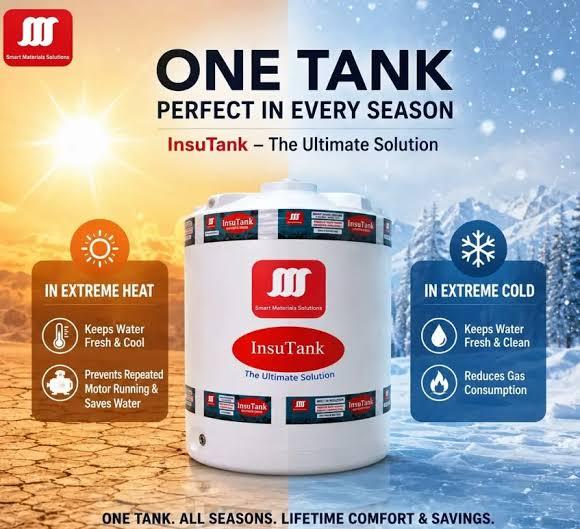
An insulated tank, like InsuTank, is built with a distinct middle layer specifically designed to slow down heat transfer — separate from the inner food-grade layer and the outer protective shell. This structural difference is what actually controls temperature, not just the number of plastic layers.
Key Differences at a Glance
| Feature | Regular Tank | Insulated Tank |
|---|---|---|
| Temperature control | Minimal | Significant |
| Needs external thermal cover | Often yes | No |
| Water in summer | Can get very hot | Stays noticeably cooler |
| Water in winter | Can get very cold | Stays milder |
| Energy cost impact | Higher (cooling/heating systems work harder) | Lower |
| Algae/fungus risk | Higher if exposed to light | Reduced with proper construction |
Which One Should You Choose?
If you live somewhere with extreme summers or winters, or you’re running a business where water temperature affects daily operations (like a school, farm, or facility with RO/chiller systems), an insulated tank is generally the better long-term choice — despite the higher upfront cost. For milder climates or lighter usage, a standard tank may still be sufficient.
The Bottom Line
The number of plastic layers isn’t what keeps your water comfortable — it’s whether the tank has real insulation built in. Understanding this difference helps you make a more informed decision instead of judging tanks by ply count alone.
